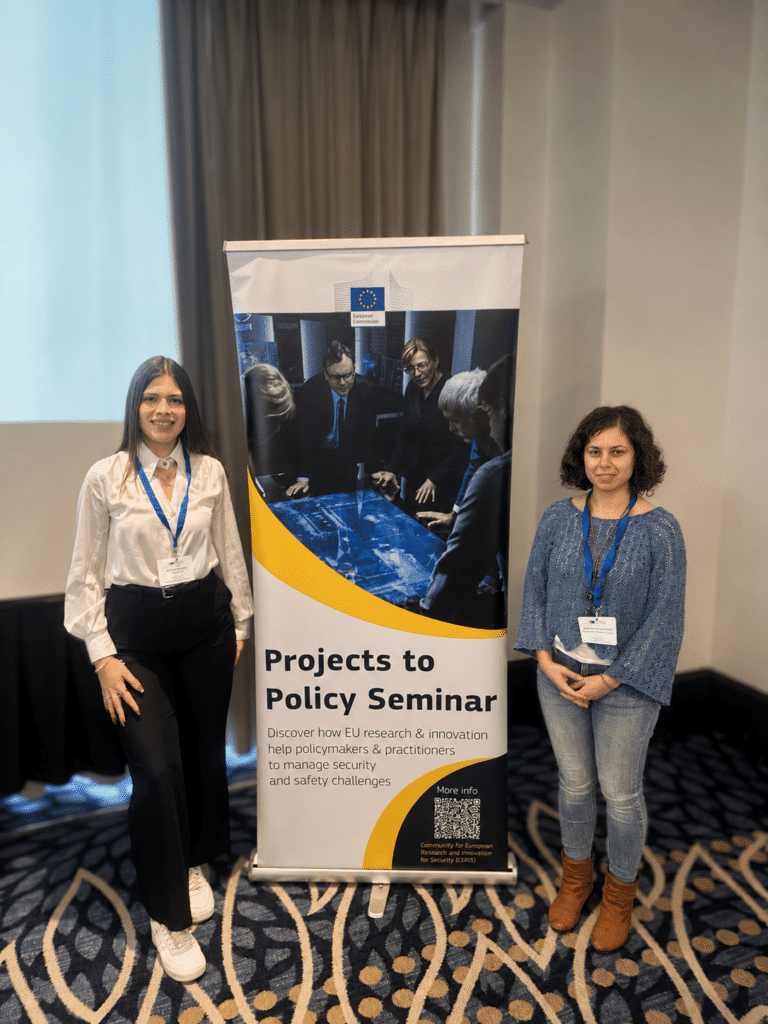
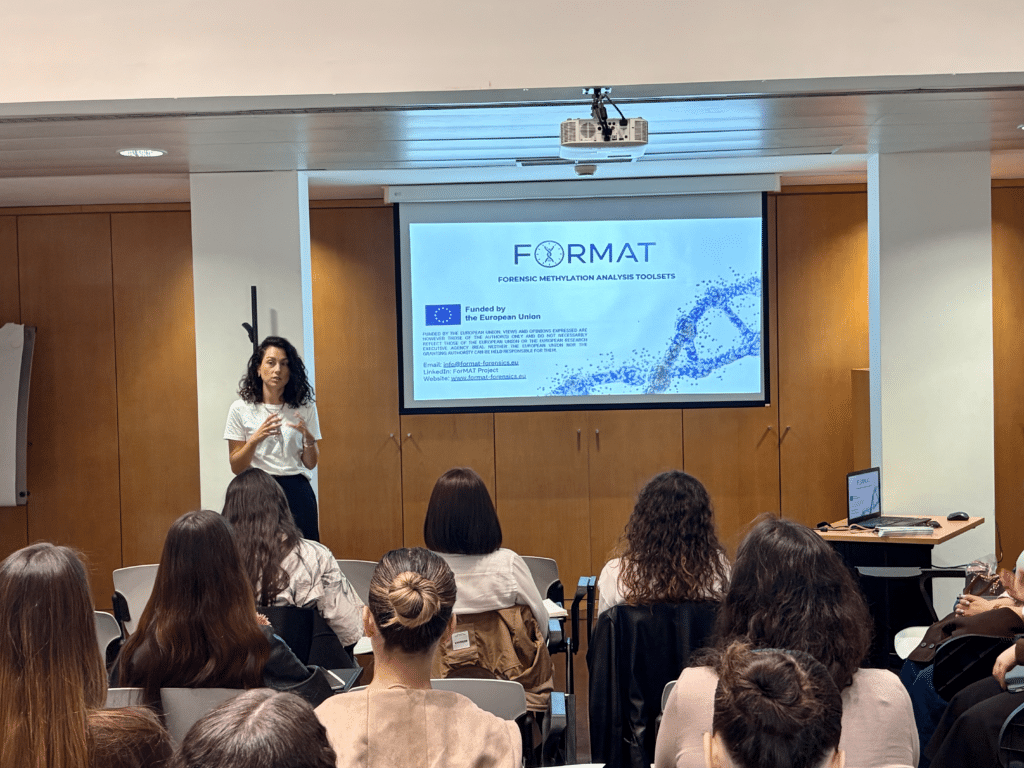
On 7–8 April 2026, ForMAT attended a landmark event in The Hague. The project develops advanced DNA methylation toolsets for forensic science under the Horizon Europe programme. Europol’s Innovation Lab organised From Vision to Impact for Horizon Europe projects. It brought together EU-funded security research projects and law enforcement practitioners under one roof for the very first time.
ForMAT team members Ana Freire-Aradas, Roberto Horcajada, Maja Sidstedt, Titja Sijen, and Alina Harbovska attended both days. They engaged with sister projects, Europol colleagues, and key stakeholders from DG HOME and the Research Executive Agency (REA).
Why this meeting mattered for forensic science EU-funded research
Europol’s Innovation Lab opened the meeting with a clear message: research only fulfils its potential when it reaches the people who need it most. ForMAT is working to move DNA methylation-based age estimation and tissue-of-origin analysis into routine use in police labs across Europe. For the project, this is not an abstract challenge. It is the central one.
ForMAT’s three pillars of impact are solving open criminal cases, expediting disaster victim identification, and providing ethical legal age assessment for asylum claimants. All three depend on one thing: law enforcement authorities must be able to use the project’s tools in real operational contexts. Furthermore, the keynote from DG HOME and REA reinforced that this is precisely what the European Commission expects from forensic science EU-funded research at this level.
Presenting ForMAT and connecting with sister projects
Day 1 gave each project a platform to introduce their work through flash presentations. These were concise, focused, and designed to spark conversation. ForMAT’s presentation outlined the project’s scientific foundation. Specifically, it covered how ForMAT builds on the results of the previous VISAGE project. It also explained how the project scales its epigenetic clock technology from TRL 5 to TRL 7, ready for deployment in operational police laboratories.
The poster session that followed was one of the most valuable moments of the two days. Participants moved freely between project displays and left questions and comments directly on the posters. This format encouraged honest, direct engagement rather than passive observation. The ForMAT team addressed questions about DNA methylation methodology, the project’s current stage of development, and its potential applications across criminal investigation, disaster victim identification, and legal age assessment.
These conversations matter for several reasons. First, they push project teams to articulate complex science clearly. Second, they surface perspectives that formal reporting rarely captures. Third, they build peer relationships that strengthen the broader forensic science EU-funded research ecosystem.
Uptake, sustainability, and avoiding the valley of death
Day 2 opened with a pressing question for anyone working in EU-funded research: how do you ensure that project results reach the people who need them? Europol’s Innovation Lab framed this challenge plainly. The “valley of death” is real. Moreover, avoiding it requires deliberate design from the very beginning of a project’s lifecycle.
DG HOME followed with an overview of the EU funding landscape. Their presentation covered the implications for long-term project sustainability. Subsequently, Europol’s Innovation Lab presented a range of platforms and tools developed in-house. These resources help project teams maximise the uptake and visibility of their results. The ForMAT team will explore them in the months ahead.
For ForMAT, the question of uptake is inseparable from the question of impact. The project’s non-invasive DNA methylation kits propose new alternatives to radiation-based medical techniques. They also give law enforcement actionable intelligence from trace DNA. Simply put, the tools only matter if they are used.
Practitioners’ perspectives: grounding research in operational reality
The afternoon session brought the practitioner’s voice into the room. Europol colleagues presented the operational challenges that forensic science EU-funded research projects could help address. In addition, a panel discussion explored what makes collaboration between research organisations and law enforcement authorities work in practice.
The conversation was grounding. Relevance is not assumed. Teams build it through sustained dialogue and genuine responsiveness to end-user needs. They must also adapt research outputs to operational environments. For ForMAT, whose ultimate beneficiaries include police investigators, forensic laboratory professionals, and vulnerable asylum claimants, this standard is non-negotiable.
Leaving The Hague with ideas — and a foundation for the future
The ForMAT team leaves The Hague with a wealth of new ideas. These come from the tools, platforms, and experiences that fellow projects and Europol’s Innovation Lab shared across two intensive days. Additionally, the connections made with sister projects will continue to inform ForMAT’s approach. The project now advances toward its next milestones with renewed direction.
From Vision to Impact was the first edition of this meeting. As a result, it has set a strong foundation for a lasting collaboration between Europol and the Horizon Europe projects community. The forensic science EU-funded research field is stronger when it stays connected. That means staying close to practitioners, policymakers, and fellow researchers pushing the boundaries of what is scientifically and operationally possible.