Every two years, the forensic genetics community gathers for the ISFG Congress, the field’s largest international meeting. This year it took place in Montréal, Canada, from 17 to 21 August 2026. ForMAT was there to present its work and connect with the researchers and practitioners shaping the field.
What Is the ISFG Congress, and Why Does It Matter?
The 2026 edition brought together more than 600 attendees from over 50 countries. Among them were laboratory scientists, academic researchers and forensic practitioners, all working at different points of the same field.
For a project like ForMAT, congresses like this one are not just an opportunity to present. They are a test. New methods get put in front of the people who will eventually have to trust them, question them and, if they hold up, use them. That kind of scrutiny is part of how forensic science earns its credibility, one conversation at a time.
A Full Week for the ForMAT Team
ForMAT’s presence in Montréal spanned four different formats, each reaching a slightly different part of the audience.
Talks, a Lecture and a Workshop
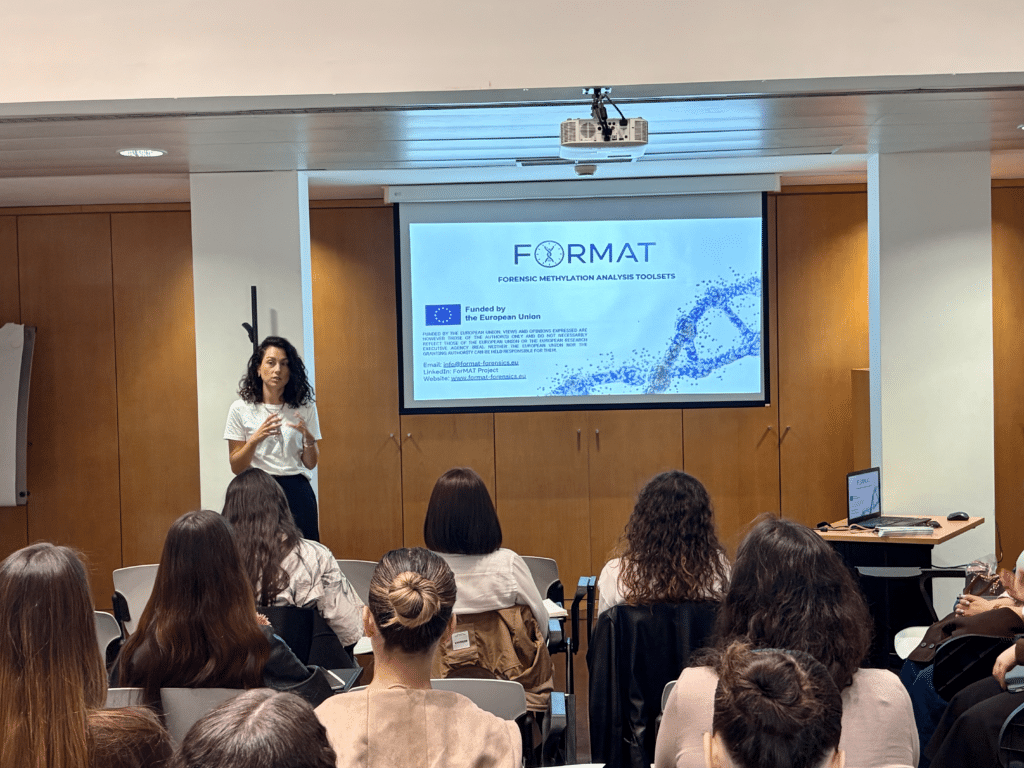
A hands-on workshop. Previous to the main congress, Ana Freire-Aradas (USC) and David Ballard (KCL) led an in-person workshop titled “Forensic age estimation using DNA methylation,” listed on the official congress program. More than 50 people attended, working through the practical side of how DNA methylation markers can be used to build a prediction models for estimating individual age. Sessions like this one exist precisely to close the gap between a method described in a paper and a method a lab can actually pick up and use.
A plenary lecture: Wojciech Branicki (JU) introduced ForMAT to the full congress audience. For a project still in its early stages, a plenary slot is a meaningful signal. It means the wider community is already paying attention.
An oral communication: Mafalda Silva (USC) took the audience through the project’s scientific progress so far. She walked through the discovery of novel age-correlated epigenetic markers in bone, using Twist technology.
Seven Posters, Seven Conversations
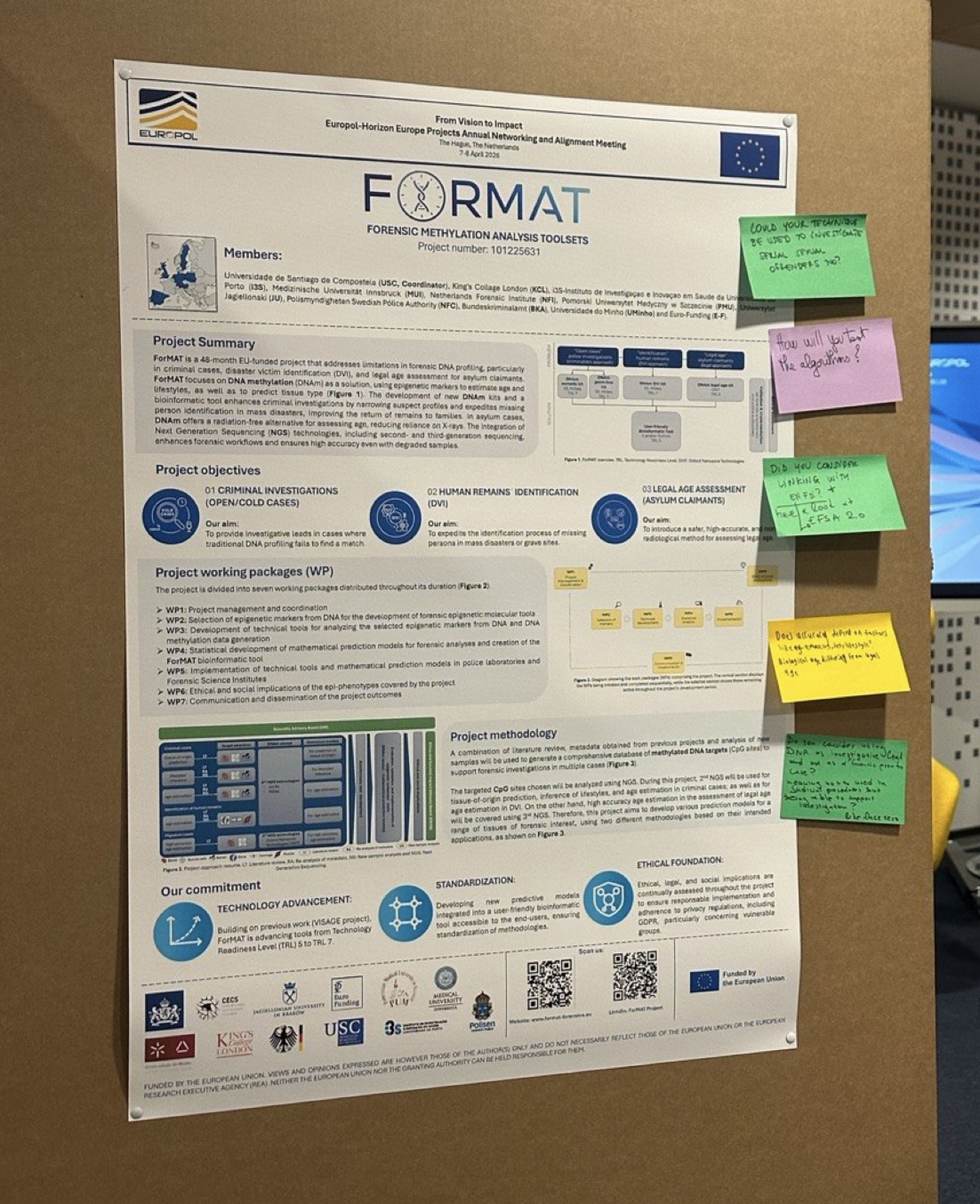
Poster sessions are where a lot of the real conversation happens, away from the main stage, one on one. ForMAT had seven posters on display throughout the week, each one covering a different strand of the project’s ongoing research:
Adrián Ambroa-Conde (USC): Selection of age-correlated multi-tissue DNA methylation markers.
Ewelina Pośpiech (PMU): Reading BMI from DNA: Cross-Tissue prediction via DNA methylation and SNPs to inform facial reconstruction.
Kamila Marszałek (JU): Using DNA methylation markers in bones and cartilage to facilitate identification of human remains.
Aleksandra Pisarek-Pacek (PMU): Forensic epigenetic age estimation in sperm cells using ForSpEC – evaluation of confounding factors.
Miguel Boullón Cassau (USC): Legal age estimation assessed using different epigenetic clocks.
Maja Sidstedt (NFC): Implementation of methylation-based age prediction in casework.
Ana Freire-Aradas (USC): Overview of the EU-funded ForMAT Project – Forensic Methylation Analysis Toolsets.
Beyond the presenters, several other ForMAT team members attended the congress. They used the week to build relationships with researchers and institutions across the field.
From Lab to Law: Why This Kind of Visibility Matters
ForMAT aims to develop DNA methylation-based tools to support forensic age estimation, tissue and body-fluid identification, and disaster victim identification.
None of that work happens in isolation. It depends on forensic laboratories willing to test new methods, on practitioners willing to point out where a method falls short, and on a scientific community willing to hold new tools to the same rigorous standard as the ones already in use.
That is what a congress like ISFG offers: a room full of exactly the people whose work ForMAT is trying to support, in one place, for five straight days. It is also a reminder that the distance between a research project and something a forensic laboratory can rely on is not only about publications. It is also about building trust, one conversation at a time — and that is exactly what ForMAT found in Montréal.
What Stayed With the Team
By the end of the week, the numbers told part of the story: one plenary lecture, one workshop, one oral communication, seven posters. But the team came back talking less about the sessions themselves and more about what happened around them: questions from practitioners that pushed the thinking further, new contacts exchanged over coffee, and early conversations about where future collaboration might make sense.
That is often how progress in a field like this actually happens: not in a single announcement, but in dozens of smaller exchanges that quietly shape what a project does next.
Looking Ahead
ISFG 2026 was one stop in a busier calendar. ForMAT will continue presenting its work at scientific and policy events as the project develops. The goal stays the same: to keep the science open to scrutiny, and to keep listening to the people who will ultimately use it.
Follow About ForMAT to see what comes next. The full programme of ISFG 2026, including all sessions and workshops, remains available on the ISFG 2026 congress website.